
A review of The Psychology of Money: Timeless lessons on wealth, greed, and happiness
Put your money where your mind is.
In his 2020 book, The Psychology of Money: Timeless lessons on wealth, greed, and happiness, Morgan Housel explores the complex relationship between money and human behavior.
Drawing on history, psychology, and personal anecdotes, The Psychology of Money presents a useful framework for reevaluating our relationship with cold, hard cash, and defining the ever elusive “enough.”
Key summary
Over the course of The Psychology of Money, Housel shares 19 short stories to explore its central theme: doing well with money isn’t necessarily about what you know, it’s about how you behave. Housel acknowledges theoretical personal financial concepts before exploring how human psychology can’t be confined within a spreadsheet.
“[Knowing] what to do tells you nothing about what happens in your head when you try to do it.”
It feels like the goal of this book is to dispense financial advice that cements its practicality in the fickleness of emotion.
Some personal takeaways:
- Money’s core value is to buy you time and energy to get and do the things you want. Something you love can sour easily with the right traits, such as taking up space from other things you care about.
- Individuals in certain tax brackets see wealth as an ego game. These folks usually do not stay wealthy long.
- It’s normal for things to go wrong and often. The successful investor continues their routine, while everyone else goes crazy.
- “The hardest financial skill is getting the goalpost to stop moving.”
- Plans need to be flexible because people change and grow. A plan that you can consistently stick to is better than the more technically accurate or by-the-book one.
General thoughts
I picked this book because I have grown tired of trying to grasp technical investing concepts and complex formulas to pick the right stocks. The Psychology of Money made me an optimist about my personal finance through its reasonable principles. These principles leveled with me in a way that made me feel wealth generation was actually possible, especially after some thoughtful reflection and an audit of what I value in my life.
Typically, I don’t enjoy anecdotes, and this is even more true when it comes to books about finance, as they are often about individuals with an income I’ll never attain in my life. But Housel did a fantastic job creating applicable lessons from each story, along with useful analysis of psychology. Even though I’d never be in some of these positions, I could see how these concepts fit into my life.
I felt the length of the book was perfectly appropriate for its concepts and topic. The book didn’t drag but took the time to expand on the questions it asked.
Housel’s writing style is engaging, like that of an academic professor who knows how to spin a boring topic into something people pay attention, with a sense of “I’ve never thought about it that way.” Similar tones are how I prefer my non-fiction to be: a sense of authority, empathy, and curiosity.
Conclusion
I enjoyed The Psychology of Money and found it fascinating. More importantly, it provided a concrete framework to re-evaluate my relationship with money and to take stock of what’s important in my life. If you’re looking for technical investing advice or perhaps you dream of earning enough to drive a snazzy sports car, this book is probably not for you (though perhaps you should still read it?). Otherwise, I’d recommend this generally because I think the idea of a moving financial goal post is something that many fellow Americans struggle with.



Browse our curated writing templates
This template appears in one of our collections, a curated group of writing templates that often appear together in to-do lists.







Why you should write a book review
People write book reviews for many reasons. Whether it’s for a college class or just to post on a site like Goodreads, writing book reviews is a valuable way to share your thoughts on a book, engage with the literary community, and even improve your own writing skills. A thoughtful, well-written review not only informs potential readers about the book's merits, but also sparks meaningful discussions.
Crafting a book review serves several important purposes:
- Share your perspective. A book review is an opportunity to express your unique take on a book. By sharing your honest opinions and insights, you contribute to the broader conversation surrounding the work.
- Inform potential readers. Your review helps others decide whether a book is worth their time and money. By providing a clear, concise summary of the book's themes, strengths, and weaknesses, you enable readers to make informed decisions.
- Engage with the literary community. Writing reviews connects you with fellow book lovers, authors, and industry professionals. It's a way to participate in the literary discourse and build relationships with others who share your passion for reading.
- Improve your critical thinking. Analyzing a book for a review sharpens your critical thinking skills. You'll learn to thoughtfully evaluate a work's arguments, style, and overall effectiveness, which can enhance your own writing and reasoning abilities.
- Hone your writing skills. Crafting a well-structured, persuasive review is great practice for any writer. As you work to articulate your thoughts clearly and concisely, you'll strengthen your writing muscles and develop your unique voice.
By taking the time to write thoughtful book reviews, you not only contribute to the literary community, but also grow as a reader and writer yourself.
Writing a book review is easy with Type, the AI-powered document editor that helps you write smarter.
How to write a book review
Starting a book review can be difficult. Here are some recommendations we have to writing yours.
When writing a book review, start by providing some basic information about the book, such as the title, author, genre, and publication date. Give a brief, spoiler-free summary of the plot or main arguments, focusing on the book's overall themes and purpose.
Next, dive into your evaluation of the book. Consider factors like the author's writing style, the strength of the characters or arguments, the effectiveness of the structure, and how the book fits into its genre or the author's larger body of work. Use specific examples to illustrate your points.
Be honest about the book's strengths and weaknesses, but avoid being overly negative or nitpicky. Aim for a balanced, constructive tone that gives readers a clear sense of your opinion and the reasons behind it.
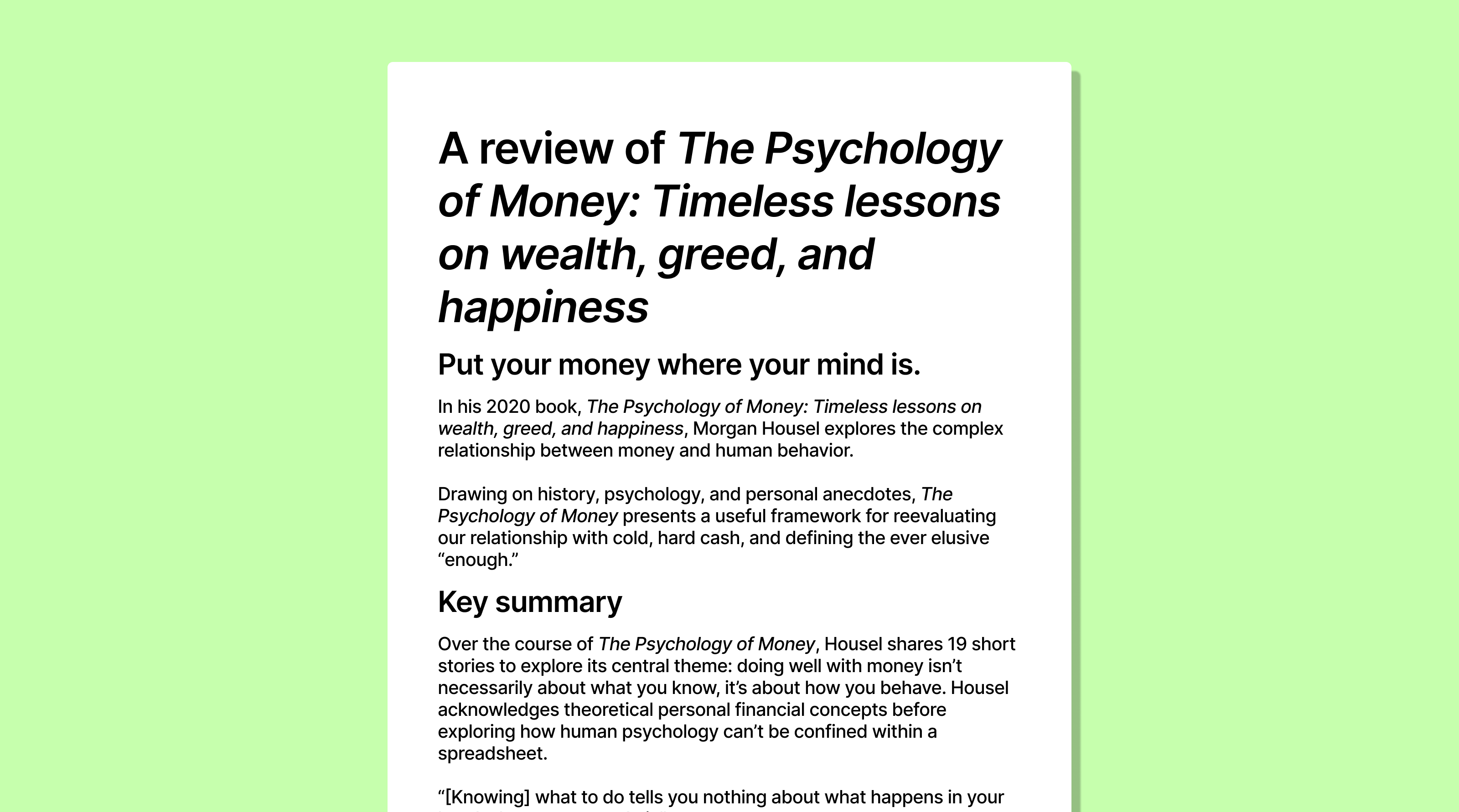
You could also use Type and our library filled with dozens of expert-curated templates to choose from, like this sample book review.
How to use this book review template
Here's how to go from our general template to a polished book review in just a few clicks.
- Open up Type, click "New Document," and select the "Book review" template from the gallery.
- Under "knowledge sources," you can include a link to the book's page on Goodreads or the author's website. This will give the writing AI more context to work with.
- Hit "Generate," and watch as Type's writing AI creates a custom book review for you in seconds.
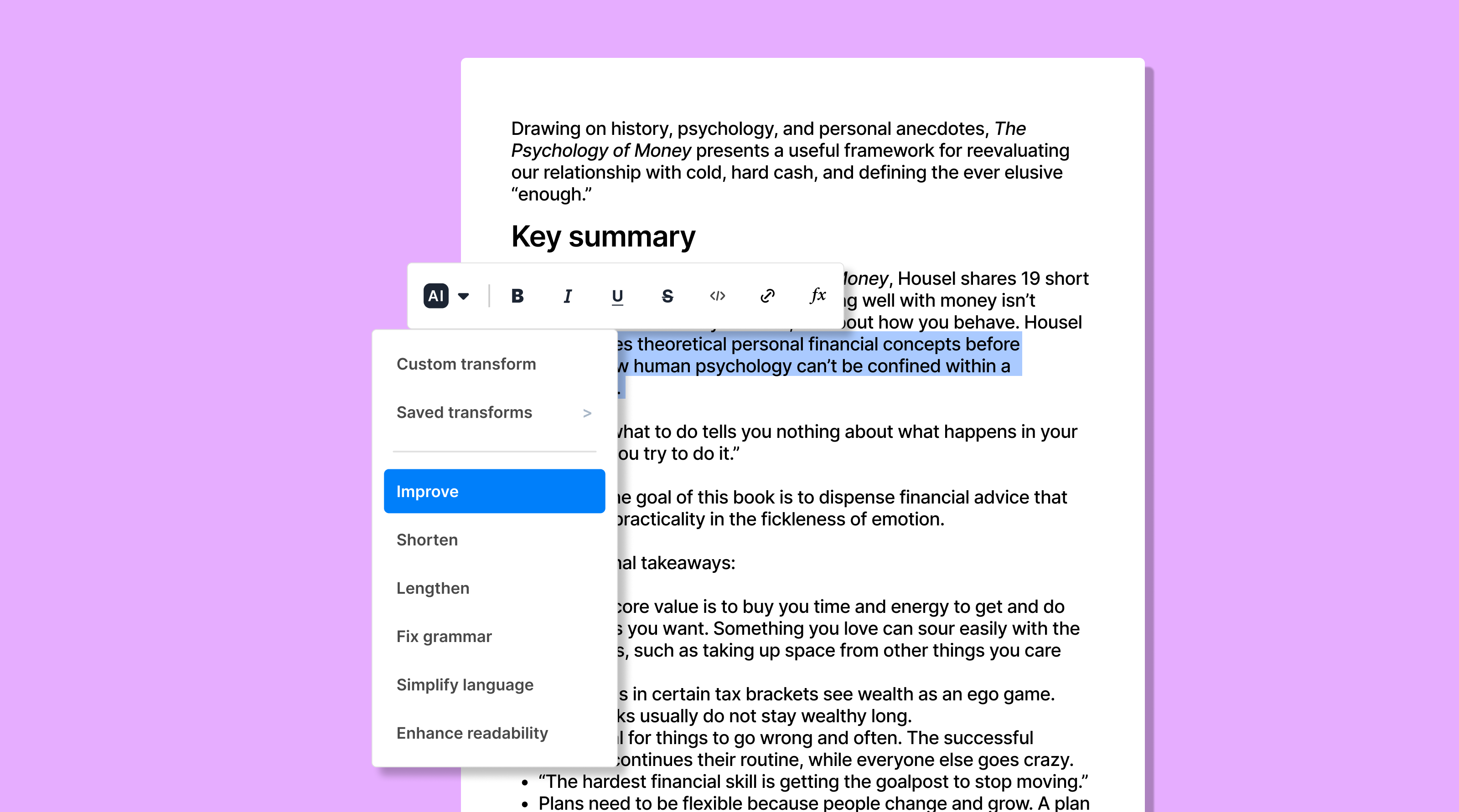
- Refine the review with our Rewrite brushes. You can adjust the tone, shorten the text, enhance readability, and more.
- Add your own personal touches with specific examples and insights from the book. If you need some ideas, brainstorm with Type Chat, a chatbot that lives right next to your document.
- When you're done, ask Type to review your work for any grammar or spelling mistakes. A polished, error-free review will help you come across as credible and professional.
- Export your completed book review from Type in either a PDF or DOC file. It’s ready for you to share, post, or print!
Best practices and tips for success when writing a book review
Before you start writing, make sure you've thoroughly read the book and taken notes on your reactions.
When writing a book review, we recommend a length of 1,000 words or less. Some key things to track as you read include:
- The main characters, themes, and plot points (for fiction) or arguments (for nonfiction)
- Passages that struck you as particularly powerful or effective
- Any questions or criticisms that came to mind
- How the book compares to others by the same author or in the same genre
- Your overall emotional response to the book
Tailor your review to your audience: Consider where you'll be posting your review and what your readers are looking for. Reviews for a personal blog can be more casual than those pitched to literary magazines, for instance.
Avoid excessive plot summary: While it's important to give readers a sense of what the book is about, too much summary can be tedious and spoil the reading experience. Focus on your analysis and insights.
Use a conversational tone: Book reviews are an opportunity to share your personality and passion for reading. Don't be afraid to let your voice shine through, while still maintaining a polished, professional style.
Proofread carefully: Nothing undermines your credibility like typos and grammatical errors. Always proofread your review multiple times before publishing.
Engage with other reviewers: Once your review is posted, keep an eye out for comments and questions from readers. Responding thoughtfully can help you build relationships and gain exposure for your writing.
How to access this book review template
Getting started with this book review template is easy. Just log into your Type account and open a new document.
Once you're in the document editor, select the "Generate" button to open the "Generate Draft" menu. Tap "Use template →" to open the template menu, where you can choose "Book review" from the options.
Your turn
Sharing your thoughts on a book is a rewarding way to engage with the literary community and grow as a writer. Let Type and our proven template help you craft compelling book reviews in a fraction of the time.
Try Type out and see how easy it is to create persuasive, insightful book reviews that spark discussion.

Join 300k+ passionate writers